Thursday, May 24, 2018

Bigger Bait Bigger Fish

Check This Out


                                           Don Moorman With Double Digit Bass #62

 I have a friend who has 63 double digit largemouth (six of which are teeners) to his credit. 63! That's insane; most folks would be happy with one or two in their lifetime but 63. Just an insanely awesome accomplishment. Now this isn't about just pumping up Don and what he has accomplished (although the accolades are deserved) this is about you and I doing some things differently to have better results on the water.

 For this discussion better results isn't about more fish in the boat but better quality fish i.e. bigger fish. Now let me say this before I say anything else catching big fish isn't an accident and it doesn't happen by chance or luck. Guys like Don do specific things that others don't or won't do.

 First they fish where big fish live. Now that doesn't mean you have to pack your bags and move to Texas, Florida or California but it does mean you need to fish the waters in your area that are either known to hold bigger fish or you suspect hold bigger fish. It's all relative. It also means having realistic goals and expectations when you set out. Even in California it doesn't rain ten pounders.

 Second they put time on the water. You can not catch fish and gain an intimate knowledge of your fishery watching tv. You MUST put the time in there is no way around it.

 Third they throw proven big fish baits now that's not saying don't throw traditional baits if that's what's working but when specifically targeting big fish larger profiled baits rule. Some folks that know me think that when I say big baits I'm talking about swimbaits but that's not completely true, I refer to all above average baits as big baits. Swimbaits just happen to be something I enjoy fishing with. Swimbaits are a tool just like jigs or soft plastics.

 Forth and quite possibly the most important is you have to be willing to fail and fail a lot especially if you plan on throwing swimbaits exclusively (which I don't do or necessarily recommend). Your willingness to fail repeatedly will separate you from the crowd. I'm not talking about blind ambition and not learning as you go along. I'm talking about learning from your failures while on this path. The most important lesson is perseverance.


  Both fish in the pictures above were caught on larger profiled baits. The fish in the top photo was caught on a 7' swimbait while the one in the lower picture was caught on a 7'' stick bait (Big Senko) two completely different style baits but similar results. (Side note: they were caught in completely different parts of the country too). Another thing these fish have in common is I put in several hours each of the respective days before landing either fish and they were both the last fish of the day and not because I quit fishing after catching them.

 Swinging for the fences isn't for everyone and to do it even kind of right is going to take a financial commitment too. For most of it you can get by with standard rods and reels but once you cross over to the Dark Side and start chunking Big Baits (I mean 4oz + baits) you're going to need some heavier job specific gear. There is too much info to cover on that subject to get into here just be prepared to drop a little cash on rods and reels if you choose to go down this path.

 As for baits everybody has their confidence baits so I'm not going to get into specifics just too much to cover but I will touch on a few general types.
1. Jigs
2. Big Worms
3. Big Stick Baits (jumbo Senkos)
4. Swimbaits
5. Big Crankbaits

 Fish the right waters. Fish!. Fish the proper baits and above all be willing to go home smelling like skunk.

Tight Lines

Monday, May 14, 2018

Dress For Success

Dressing For The Conditions


 Can make all the difference in having a great day on the water or a not so great day. Being prepared for at least some of what Mother Nature will throw at you will not only help you have an enjoyable day but it may well save your life.

 I'm not just talking about wearing your PFD what I'm talking about is the best quality clothing you can afford for the conditions of the day and time of year.

 We're coming into summer and there are a lot folks out there that take sun exposure with a grain of salt but I'm here to tell you for first hand experience you do not want to be a heat related casualty. I've had two severe sunburn in my and suffered from heat exhaustion a couple times too. I'm not sure which was worse not being able to sleep or the nausea, vomiting and diarrhea. Not to be graphic but just to explain just a little of what can happen with too much sun and heat.

 So this summer try to stay covered up while on the water with at least a hat, sunglasses neck gaiter, long sleeved shirt and pants. You can work on your tan at the beach or pool. Don't let overexposure ruin your weekend.

 Lastly drink plenty of water. I try to down a gallon a day and it makes a difference. I can't comment on limiting caffeine intake since I'm drinking coffee while I write this. Sports drinks are good in small doses but don't over do it. Water is your friend.

Tight Lines

Back To The Basics

 I can't catch a cold let alone a fish.

 Then I get people asking me, "what do you recommend I use to get started fishing"? I don't know! A crank phone? Maybe dynamite? We all go through slumps or dry spells but there are ways out of it. You probably won't see an instant turn around but what if you could put two fish in the boat vs none?
  I was listening to a former NFL cornerback speak one day and he was talking about getting out played in one particular game and the way he portrayed it it was ugly. On their way home from the game the coach pulled him to the side (he was thinking he was in trouble) and the coach told him something to the effect, "When the game is getting away from you go back to the fundamentals". 
 So what are the fundamentals of bass fishing? If you want to get real basic, a piece of string, a hook and some sort of bait. What do I consider the basics? Well, I'm glad you asked. I'm going to skip over rod selection and knots and all of that stuff and talk about the things I think are the basics for breaking a slump or just putting fish in the boat. I can't speak for anyone else so take this for what it is, just one dude's point of view.
 First off I do a "check up from the neck up". What am I thinking about? Am I focused on the task at hand or am I thinking about whatever else is going on in my life real or imagined? What is your self talk like? Is it positive and focused on catching fish or are you in a negative spin cycle not controlling your thoughts? Another thing that I think is one of the most important aspects for me personally is expectations. Do I really expect to catch fish? Am I tuned in to what is going on in the here and now? Am I feeling confident? Here's one for you; Have you ever had the feeling a fish was going to be in a certain spot and pulled one out of there? That has happened to me numerous times. The only way I can explain it is like this. There is knowing an area should or does hold fish and then there is have a gut feeling and knowing there is a fish in a certain spot. That brings me to my next point.


I had "that feeling" a fish was against this short stretch of bank and pulled this girl out from her spot.

 Time on the water. You didn't get good at your job by not showing up and not working while you are there. The only way to truly get good at anything is to practice at it. Period. End of discussion. Contrary to what most people think fishing is not luck. I understand there are lucky catches where the newbie angler lands a giant but I'm not talking about them. I'm talking about the folks that put in their  time that's not luck. When you see guys that have multiple Double Digit Bass to their names or your friends that just seem to have a knack to catch fish, that's not luck. That is skill, knowledge of the waters they fish and confidence in their abilities and the tools at their disposal. And you don't get any of that watching The Real Housewives.
 Go where the fish are. Yep I said it and it's true. For me I have to know I have a shot at a decent fish but I also need to be able to shake the skunk off at the same time. So I fish just a handful of places consistently. I look at it like this; I would rather have an intimate knowledge of two or three places and know how to fish them well then to "butterfly" from spot to hoping I get lucky. By learning to fish a few places well you build a foundation on which to (re)build your confidence. Let me make one point here though. There is a huge difference between fishing a pond in somebody's back yard and fishing a public lake or river that gets some pressure. A pond will trick you into thinking you actually know how to fish. Don't get sucked into that trap, get on public waters and you'll be a better angler for it.
 Last and probably least is the tackle. The basics are the basics and there are a few lures/techniques I think everyone should learn.
1. A Texas Rigged Worm- When all else fails this is my #1 confidence technique more fish have fallen to this than any other technique. When I'm in a slump this is the first place I go.
2. Spinnerbaits- Although I've gotten away from them in the last few years I can't tell you how many fish I've caught on a spinnerbait and it is still one of my favorite night time baits and a killer river bait.
3. Wakebaits and Poppers- Something to dead stick or creep along on the surface.
4. Toads- Not hollow bodied frogs but toads. Something I can rip across the top that is a little subtler than a buzzbait but is weedless that I can fish just like a buzzbait.
 Those are my confidence/rebuilding baits or techniques. The reason I saved it for the last and say it is probably the least important it because they are what I use for my confidence. If you ask somebody else they are probably going to give you a different answer. So what are your confidence baits? What are you going to do to drag yourself out of the got another skunk blues?

Tuesday, April 24, 2018

What Is A Big Bass?


I Ask Myself This All The Time

 What is a big bass? What's the standard by which we should measure? In the world of bass anglers  a 10# largemouth is a true giant but is it really? Should the world record be the standard? Or should we use state records? Or is there a better way?
 Now let's take it one step further and split it into three specific subspecies of black bass. The largemouth, smallmouth and spotted bass.
  I've taken the time to get a rough average of each species by state record. I rounded up or down to the nearest 1/4 pound for this discussion. We don't need to be perfectly accurate we just need a rough guide to go by. Let's get down to the business at hand.


Largemouth Bass

 The world record is 22 pounds 5 ounce caught in Lake Biwa, Japan by Manabu Kurita is now the benchmark that all other big bass will be measured against but is that a fair comparison if you live in Iowa? What about California? It produced Dottie and a 22 pound 3 ounce giant. I don't think so.
What about the other two popular strains of black bass?

Smallmouth Bass

 The world record is 11 pounds 15 ounces caught in Dale Hollow Lake, Tennessee by David Hayes in 1955.


Spotted Bass

World record spotted bass 11 pounds 4 ounces caught by Nick Dulleck in New Bullards Bar Reservoir California.


Average State Record Weights

 Not every state has all species of bass for example only 49 states have largemouth (Alaska being the lone state with no bass) so the weights listed are a rough average for the states that have recorded a state record for that species of fish.

Largemouth - 13.75#   (49 states)

Smallmouth - 7# even (48states)

Spotted Bass - 6.5#      (23states)

Here's The Deal

 I use two separate standards I use the average weights above and more importantly the given body of water I'm fishing. Since I've caught a couple double digit largemouth my constant goal is to break the 10 pound mark every year. The reality is knowing 10 pounders are rare animals and the national average state record is 13.75 pounds, so I believe a 7 pound fish is a trophy regardless of where in the country you fish. I also think that if we could open the heads of every bass angler out there and find out the real truth we'd find out that most of our personal best largemouths would probably be about 6 pounds. Which is a really good fish and nothing to be ashamed of.

 The problem is with our perception of what a trophy fish is. The fact that we have access to so much information so quickly from so many parts of the country it has distorted our perception of reality.
 A guy catches a 7# largemouth from a strip pit Southeast Kansas; is it any less of an accomplishment than a guy in Texas or California catching a 12 or 14# fish? I would argue no. It's all relative. You can make the same argument using different bodies of water in a given state. Again. It's all relative.


 In the above picture I'm holding a 16" spotted bass and I was pumped. That fish is only two inches away from my initial goal of an 18" 3# fish from that creek. I know fish in the 18" range live there because a friend has caught one and we have both seen what we believe to be 20"+ fish in that area but until one of us breaks the 20" mark, 18" is the standard. (BTW the Alabama state record spotted bass is 8 pounds 15 ounces).

 Here's the bottom line, if you catch a fish that's half way to a state record (regardless of species) you've done something. Keep going after what your big fish is. Focus on your goals and try to block out the white noise of our wired world.You can do this. You can score your new personal best. You just need to figure what that is and go after it.

Wednesday, April 4, 2018

Making It Your Own

           Making the Trident 13 into the ultimate utility boat.


 Hands down my favorite kayak is the Trident 13. I have four kayaks in my garage and it's the one I choose to fish out of probably 90% of the time and for good reason. Its fast, tracks well, handles moving water with confidence and is stable enough to stand and sight fish from. And with the changes made to the topside rigging has never been easier. 

 Rigging a kayak is about making it your own but before you go hacking holes in your new boat to add the latest version of Acme's Margarita Blender, stop and think about it. Put some time on the water with her and see what you really need and/or want. I've made the mistake of putting accessories on and making permanent holes only to find out later I either didn't use the accessory or didn't like it. Seriously give it some thought.

  I mentioned changes that were made to this new generation of Trident  and I'll be talking about a few of them. Before I go into the changes made by Ocean Kayak I just want to mention something I like to do to all my boats and that is add a rudder.  There are a lot of benefits to having a rudder that I won't get into now but let's just suffice it to say they are worth every penny.

 Back at the ranch. I want to point out a couple of changes that have been made that have aided in rigging kayaks more than anything and that is the manufactures add on rails and mounting plates as part of the kayaks straight from the factories. By doing that it has made it easier and less stressful for us the end user to modify our boats. As far as the Trident 13 is concerned it has three key changes I really like.
1. The accessory rails fore and aft.
2. The center hatch.
3. The seat.

 The rail system is self explanatory, the hatch though is really cool it allows you to mount rod holders and what not but it also has this cool little compartment that I've taken the cover off of and use as a catch-all.


  As for the seat I've removed the thigh adjusters and added a gel cushion. Several years ago I dinged my back up a little and by making a couple small adjustments to the seat I'm able to sit in this boat almost all day with out having to get out and stretch too often.


 So you see you can make changes to your craft that are free or cost very little that can make a huge difference to you and in the end that's what its all about. I do have a kayak with extra rod holders and electronics on it but like I said early on this Trident is my goto boat and as I'm writing this its in the back of my truck wait on the next adventure. So for me and maybe you too that the ultimate in fishing and outdoor experiences isn't necessarily about the latest waypoint you mark on your GPS or Side Imaging  but being part of nature without the white noise of the wired world.

Tuesday, September 20, 2016

Getting Started Part 1

 This is going to be a three part series so be patient with me. I get asked how to get started occasionally but over the last couple of months it's happened a little more than I normally get asked. So I figured I  would try to put my thoughts on this into words and see if it can help a couple people at least get pointed in the right direction. Now before we get started let's get something clear. This is just my point of view and it's based on what has worked for me.

 In this first entry I'm going to cover some basic tackle I think will work for just about any lake or river in the county. After that I'm going to talk about putting that stuff to work then getting off of the bank and being able to cover more water.

  I want to keep your load light but effective. I also want to keep it as inexpensive as possible at first. You should be able to start fishing on the cheap without buying junk equipment. Pawn shops and secondhand stores are great places to find quality gear for a lot less than paying retail.

 As far as gear/tackle goes you really don't need a lot to get off to a good start. Here is a short list of tackle get you rolling. Assuming you're brand new means there is a high likelihood you will be bank fishing, the first item on the list is:

- Backpack: Nothing special just something big enough to hold two 3700 size boxes like the on in the picture below, drinks and a snack.


 The place I would encourage putting any real money is in you rod/reel combos, I suggest getting two combos to start. One spinning and one baitcaster combo. I highly recommend learning how to use a baitcaster.

- Spinning combo 6'6"-7' medium power/ mod fast to fast action.


- Baitcaster combo 7' med/hvy fast with a 6.3:1 reel.


These two combos will cover 90% of all the fishing you will probably ever do. EVER.

 You really only need a handful of lures and I think these should be in your arsenal.

- Spinnerbaits in white, white/chartreuse and black.


- Buzzbait in the same colors as the spinnerbaits.


- Lipless crankbait aka "Rattle Trap" in chrome with a blue back.


- Plastic worms in ribbon tail and straight. I like to stick to just a few colors; Black, Junebug and Green Pumpkin Seed. I also like Green Watermelon Seed.


 This is definitely not a complete list but it's enough to get you started and keep you busy for a while.There are a couple lures I would like to add to the list but I want to keep this a simple as possible for now.


Sunday, June 21, 2015

The Night Life

 Considering this is becoming my preferred time to fish I thought I might share my take on night fishing. I doubt I'm going to cover anything that hasn't been covered before but maybe I can put some info out there that helps somebody put some fish in the boat and go home in one piece all at the same time.

Five pounder caught on a jig.

  Before we get started lets talk about what it takes to get home safely. This is the most important part of the whole deal, none of this is worth getting hurt or dead over so use your brain and a little common sense when on the water.

-The first thing to do before you go out at night is to let somebody know where you are going to be that way if something happen they know where to start looking if the worst comes to pass.

-Second, don't be an idiot, you need to know the water you are going to be on. After dark is not the time to try to learn new waters, fish it during the day several times before you attempt to solo fish a place after hours. Although it's probably best to fish with a partner I generally end up fishing alone most of the time. I never fish a place for the first time by myself at night.

-Third, be prepared for emergencies have a way to mend small wounds and remove hooks from yourself or your fishing buddy. Also be prepared to deal with the really bad things that can happen when the lights go out. We have some really big toothy critters in these parts and a carbon fiber paddle is no match for a 500 lb. alligator and Heaven forbid you ever have to defend yourself out there but it can happen and you need to know how to deal with any situation that arrises.

Only carry if you are willing to deal with the consequences of your actions.

Having the tools to remove hooks and to cut rope and fishing line is a necessity. Don't leave home without the tools to do the job.
  As the adage goes "Two is one and one is none". When it comes to lights at night you need a minimum of two sources of light and they need to be in good working order. I like to wear a ball cap when I fish so a clip on light seems to be the handiest thing for me to use personally. Just find something you can get used to that will keep you hands free. A handheld flashlight just doesn't really cut it. Also having red lights will help to preserve your night vision. Last but not least if you are fishing public waters have a white light that is visible for all 360 degrees that way any boaters out there can see you.

My light pole is an old Mag Light stuck in a piece of 3/4" PVC and the end cap is a protein drink tube. You don't need to spend tons of money on this stuff, it just needs to work.
   A few last house keeping items before we go fishing and they both have to do with being comfortable on the water.
1. Wear your PFD.
2. Dress to be comfortable. Don't forget rain gear getting drenched sucks but wearing comfortable clothes is just as important at night as it is during the day. Also having a jacket can be nice.
3. Bring food and water.
4. Bug control. I use a spray and a ThermaCELL.
5. Keep the cockpit of your kayak clear of clutter only use one rod at a time and keep all tackle and gear stowed and out of the way.

I leave my ThermaCELL burning until I have my kayak tied down and I'm ready to go home.
Now lets go fishing!
 I see on fishing forums all the time, questions posted about night fishing and it is almost totally predictable that they are going to ask the same three questions every time.
What baits to use?
What areas do you target at night?
What time of night?

What bait to use?

 The same baits you use during the day. I will fish black or darker colors at night the more often than not but the truth is black and dark colored baits are more of a confidence thing for me. Shad, lizards, crawfish or any other prey item don't magically turn black once the sun goes down BUT knowing when to use darker baits can lead to success. I have found that dark baits are not an automatic at night, I take water clarity and ambient light into consideration for bait choice. If the water is clear and I have good ambient light like a full moon or plenty of street light or dock lights I will fish light colors. If the water is murky or there is little ambient light I will lean towards dark colors. Bass have excellent night vision, along with their lateral lines to sense movement and pressure changes in the water and a good sense of hearing, they have no problem locating prey. I think we as humans don't give them enough credit in their abilities in that department. They are the apex predatory fish in many bodies of water for a reason.

A good sample of the baits I use at night.

What areas do you target at night?

 I fish the same areas at night as I do during the day although I tend to focus heavily on flats and dock lights at night. A flat that has a distinct ledge can be a gold mine. Also anywhere creeks feed into the main body of a lake or cove. Fishing from a kayak forces you to break down a body of water into bite sized chunks. A cove on a lake might be all you can fish in a few hours of work so you need to fish that cove as if it is it's own body of water. Analyze that cove. Is there a feeder creek coming into it? Does it have a flat or flats to fish? Shear walls? Drop offs, humps, holes or an old roadbed? Day or night I like to fish creeks and flats it just fits how I prefer to fish for the most part. One thing that I have found is bass will still orient towards ambush points even at night. Logs, clumps of grass and small holes are spots to target even when the lights go out.


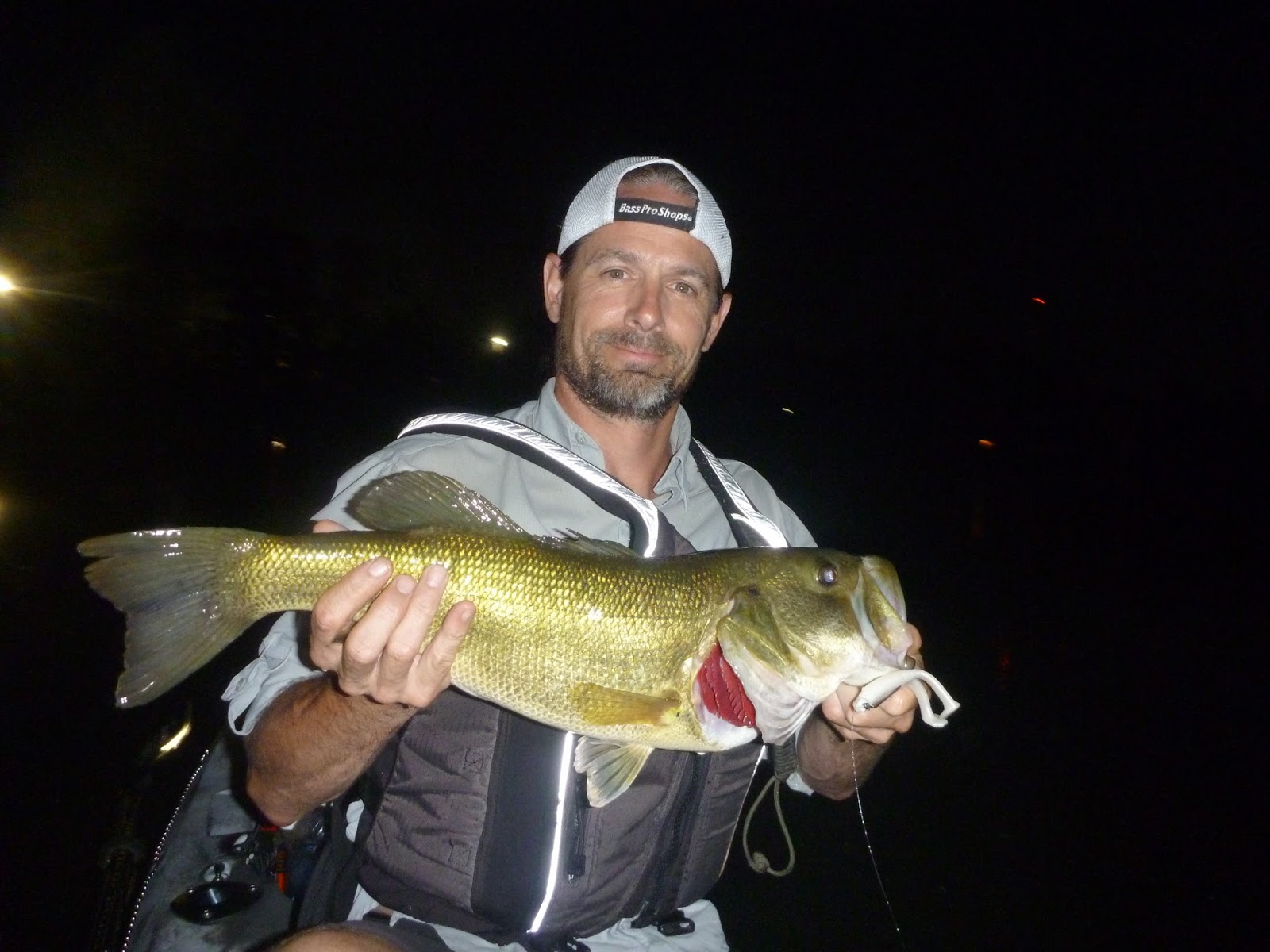
 All three of the fish pictured above were caught in the same lake but the under the water is different from spot to spot where they were each caught. The top fish was caught on the outside edge of a cove next to a drop off in about six feet of water. The center fish was caught next to the bank along a channel ledge (the channel being about 9'-10'  deep in that area) and the bottom fish was caught right in the middle of a flat in about 3 feet of water.

What time of night do you fish?

 This goes back to one of my first statements about being safe on the water and knowing the water your on. You also need to learn the feeding patterns of the fish in the place you are fishing. For my main honey hole I have found the fish like to feed just before sundown and the hour just after that and they will pick up again about every two to three hours for twenty minutes or so in each of those windows so I need to be in place and ready when they start feeding because I will miss out if I'm not ready when they are.

 Ultimately success night fishing comes down to location, preparedness and knowing your home waters . You can't catch big fish if there are none where you fish. You can't have success if you are unprepared both mentally and physically. Lastly know thy waters. The only way to know your waters is to put the time in. Go put in the time, experiment and have fun with it, lose some sleep and hopefully catch a new Personal Best!

Tight Lines

H